Refined from the inside. No visible trace.
Closed rhinoplasty in Rawalpindi by Dr. Jawad Jahangir. For subtle change without an external scar — the considered choice when your nose needs refinement, not rebuilding.
- 4.9 · 1,717 Google reviews
- 15+ years · 1,000+ rhinoplasties
- Rawalpindi · Islamabad
Private · A 30-minute conversation, no pressure to book.
What Closed Rhinoplasty Means
Closed rhinoplasty — also called endonasal rhinoplasty — is the technique where every incision is made inside the nostrils. No external cut, no scar across the columella, nothing visible on the skin once healing is done. The cartilage and bone are reshaped through the nostrils themselves, working within the existing framework rather than lifting the skin away from it. For honest, well-defined refinements — a small dorsal hump, a modest tip adjustment, narrowing of the bridge — closed is often the better technique. It is faster to recover from, gentler on the tissues, and leaves no trace anyone can see. Open rhinoplasty is the considered choice for structural rebuilds and revisions. Closed is the considered choice when the work is refinement.
The right technique is the one your nose asks for.
Before, and after.
A patient at consultation, and the same nose after closed rhinoplasty by our team — an anaesthetist, a plastic surgeon, and an ENT surgeon operating together under the supervision of Dr. Jawad Jahangir. Photographed under the same lighting, no filters, no retouching.
-

Before -
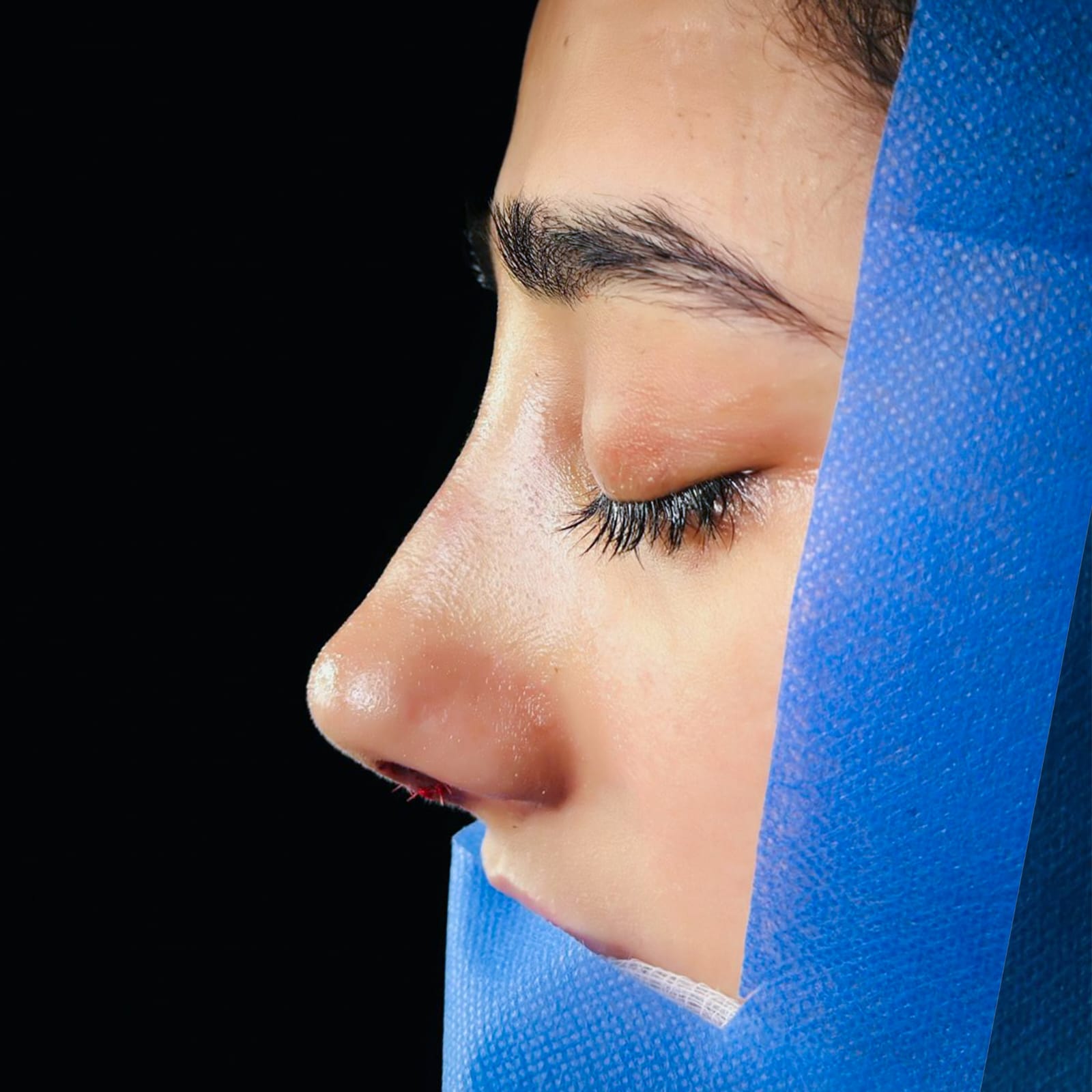
After
When Closed Rhinoplasty Is the Right Choice
Closed suits noses that need refinement on a sound framework — the bones are well-positioned, the cartilage is structurally healthy, and the change you want is honest and proportionate. If the work is bigger than that — a revision, a complex tip, a crooked nose from trauma — the open approach will hold its shape longer. We will say so in consultation. Below are the situations where closed is usually the better answer.
- Small to moderate dorsal hump Reducing a bridge bump on an otherwise straight, well-supported nose.
- Subtle tip refinement Softening a slightly bulbous or hanging tip when the underlying cartilage is strong.
- Bridge narrowing Bringing the width of the nasal bones closer to the line of your face.
- Septoplasty with cosmetic refinement Correcting breathing and shape in a single procedure — without an external incision.
- Patients who cannot accommodate a scar Cultural, professional, or photographic reasons that make even a faint columellar scar a problem.
- A faster, quieter recovery Less swelling, fewer external bruises, and a shorter window before you are back in public life.
Inside the Procedure
Closed rhinoplasty is shorter than open — usually one and a half to three hours under general anaesthesia — but the work is no less exact. The surgeon operates through the nostrils, by touch and direct view, reshaping cartilage and bone within their natural envelope. The skin is never lifted, which is why bruising and swelling are typically lighter. What follows is what happens, in plain terms, from your first consultation to the morning after surgery.
-
Consultation and assessment
Dr. Jawad reviews your concerns, examines your nasal structure inside and out, and discusses whether closed is the right technique for your nose — or whether open would serve you better. No pressure to book.
-
Surgical planning
Photographs, measurements, and a written plan tailored to your anatomy and the result you want. You see the plan before the day.
-
The day of surgery
Our team — anaesthetist, plastic surgeon, and ENT surgeon — operates together under Dr. Jawad Jahangir's supervision. General anaesthesia, fine incisions inside the nostrils, and reshaping of the framework through the nasal opening. Most cases run one and a half to three hours.
-
Reshaping and closing
Cartilage and bone are refined to the planned shape; the internal incisions are closed with dissolvable sutures. No external stitches, no visible mark on the skin.
-
The first 24 hours
You rest in our recovery suite, then go home the same day in most cases. A small splint protects the bridge for a week; a discreet driver and companion can be arranged.
What Recovery Actually Looks Like
Closed rhinoplasty heals faster than open — not by a different order of magnitude, but enough that most patients describe it as a gentler experience. There is no external incision to manage, swelling is more contained, and bruising is usually lighter. The honest version still includes a final settling period; the shape your surgeon promised at the end of the operation is the shape you will see in photographs months later, not in the mirror that first week. Here is the realistic week-by-week.
- Week 1 Splint on, internal congestion that feels like a heavy cold, mild bruising. Low-grade discomfort managed with prescribed medication. You stay home.
- Week 2 Splint comes off. Bruising, if any, has softened to a tone that covers with makeup. Most patients return to desk work.
- Weeks 3–4 Visible swelling settles meaningfully. Friends may notice nothing more than that you look rested. Light exercise resumes.
- Months 2–3 The shape becomes recognisably yours, refined. You can attend events without anyone asking questions.
- Months 6–9 Final settling. The tip — last to soften — finds its true line. This is the photograph you were waiting for.
Why JJ Aesthetics for Closed Rhinoplasty
Fifteen years. 1,000+ rhinoplasties. 1,717 Google reviews averaging 4.9. Closed rhinoplasty rewards the surgeon who can read a nose without lifting the skin to look at it — the work is done by touch, judgement, and a clear plan made before the first incision. Choosing a rhinoplasty surgeon is not a comparison of price lists; it is a decision about whose hands you trust to make permanent changes to your face.
-
A multidisciplinary surgical team Anaesthetist, plastic surgeon, and ENT surgeon operating as one — under the supervision of Dr. Jawad Jahangir, with 15+ years of practice and 1,000+ transformations behind the work.
-
4.9 stars across 1,717 Google reviews Read them before you call us.
-
Honest pre-operative counsel If open rhinoplasty, a non-surgical option, or no surgery at all suits you better, we will say so — before you commit.
-
Continuous post-operative care Scheduled reviews at week one, week two, month three, and month six. You are not handed off after surgery.
Private · A 30-minute conversation, no pressure to book.
Everything You'd Ask at midnight.
Will I still look like myself after closed rhinoplasty?
Yes, if that is the goal you set — and with closed rhinoplasty it almost always is. The technique respects your existing framework rather than rebuilding it, so the changes are refinements your friends will register as “you look rested,” not “you look different.” The “operated” look most patients fear comes from over-reduction. We do not over-reduce, and we will tell you in consultation which changes will preserve your face and which will not.
How is closed different from open rhinoplasty?
In closed rhinoplasty, all incisions are inside the nostrils — nothing visible on the skin. In open rhinoplasty, the surgeon adds a small 4–5mm incision across the columella (the strip between the nostrils) to lift the skin and see the framework directly. Closed is faster to recover from and leaves no external scar; open gives the surgeon direct view and is the better technique for complex reshaping, revisions, and structural rebuilds. Which one suits you depends on the work your nose needs, not on preference.
Will I have any scar at all?
No scar that anyone will see. All incisions are inside the nostrils, where the lining heals into faint lines invisible from the outside. The skin of your nose is never cut. This is the principal reason patients choose the closed approach — the result reads as natural in photographs from any angle, including the under-the-chin view that gives away a columellar scar.
How experienced is Dr. Jawad with closed rhinoplasty?
Dr. Jawad Jahangir has practised aesthetic facial surgery for over fifteen years, with rhinoplasty as a primary focus. Closed rhinoplasty at JJ Aesthetics is performed by a multidisciplinary team — anaesthetist, plastic surgeon, and ENT surgeon — operating together under his supervision, so each part of the procedure is handled by the specialist trained for it. The practice is reviewed by 1,717 patients on Google with a 4.9 average. Ask in consultation to see before-and-after photographs from cases similar to yours.
What does closed rhinoplasty cost at JJ Aesthetics?
We do not publish a single price because every nose is different — the complexity of the work, time under anaesthesia, and whether septoplasty is included all matter. Closed is typically priced slightly below open for primary cases of comparable complexity. You receive a clear, all-inclusive figure in consultation that covers surgeon, anaesthesia, theatre, and follow-up care. No add-on bills after the fact. If you message us on WhatsApp with a brief description of your concern, we can give you a realistic price band before you come in.
How painful is it, honestly?
Less than most patients fear, and generally a touch easier than open. The most common description is pressure rather than sharp pain — a feeling of congestion through the first week, managed with prescribed medication. Most patients are off pain relief by day four or five. Bruising and swelling are usually lighter than after open rhinoplasty because the skin is not lifted.
How do you decide between closed and open for me?
In consultation, by examining your nose inside and out and listening to what you want changed. If the framework is sound and the work is refinement, closed is usually the answer. If the change is structural — a revision, complex tip work, asymmetry from trauma, significant cartilage rebuilding — open is the technique that will hold its shape long term. We do not push one technique because it is faster to perform or pays better. We recommend the one that will serve your face in ten years.
Can I keep this private — will anyone need to know?
Yes — and closed rhinoplasty makes that easier than most cosmetic procedures. Consultations are scheduled discreetly at our Rawalpindi clinic. Surgery is day-case in most situations. The visible recovery window is roughly two to three weeks; we plan your surgery date around weddings, work cycles, and travel so you return to public life looking rested, not recovering. Records are kept confidential, and photographs are never used without written consent.